Few flowers have been asked to carry as much as the lily. Across five thousand years it has stood for kingship and for death, for a virgin's chastity and for frank sexuality, for the soul's rebirth and for the simple peace of a garden at dusk. The same trumpet-shaped bloom that announces the Virgin's purity in a Renaissance altarpiece signals resurrection on a Victorian mourning brooch and rises, faintly scandalous, in a modernist close-up. What follows is a tour through eight works in which the lily means eight different things — proof that a symbol is never fixed, only borrowed, again and again, by whoever needs it.
A note on botany before we start: many of these "lilies" are not true lilies at all. The Egyptian lotus is a water lily, the calla is an arum, and the heraldic fleur-de-lis may derive from an iris. But the idea of the lily — tall, pale, ceremonial — is what travels, and that idea is the real subject here.
Purity

Sandro Botticelli, Cestello Annunciation, 1489–90, tempera on panel, Uffizi Gallery, Florence.
The Archangel Gabriel, having just alighted, extends a stem of white lilies toward the Virgin Mary. This is the lily at its most canonical: the Madonna lily, attribute of Mary and shorthand for her virginity and purity. Botticelli choreographs the encounter so that the curve of Mary's swaying body answers the curve of the lily stem, binding flower and woman into a single gesture of grace and acceptance. For centuries of Christian art, no Annunciation was complete without this flower; it is the reason "lily-white" still means spotless today.
Innocence

John Singer Sargent, Carnation, Lily, Lily, Rose, 1885–86, oil on canvas, Tate Britain, London.
Two small girls in white dresses light paper lanterns in a darkening garden, surrounded by roses, carnations, and tall white lilies (likely Lilium auratum). Sargent painted it outdoors over two autumns, working only in the few minutes of perfect dusk light each evening, replacing the flowers with artificial ones as they died. The whitened children and the white lilies rhyme visually and emotionally: the lily here reads as childhood itself — luminous, fragile, and about to be swallowed by the coming dark. It is the picture's quiet melancholy, not just its prettiness, that makes the innocence feel real.
Grief

Victorian mourning jewelry, England, c. 1837–1901 (examples held in collections such as the Victoria and Albert Museum, London, and the Museum of Whitby Jet).
This is a genre rather than a single masterpiece, but no survey of the lily can skip it. Victorian mourners spoke in floriography — a coded language of flowers — and the lily was one of its most eloquent words. The white Madonna lily, carved in jet or worked in enamel and pearls, stood for the restored innocence and purity of the departed soul; the lily of the valley, a favorite of Queen Victoria herself, meant the "return of happiness" and the promise that sorrow would pass; the calla lily signaled resurrection. Worn against black crepe, these blooms let grief say what etiquette would not allow spoken aloud.
Struggle

Diego Rivera, The Flower Vendor (Girl with Lilies), 1941, oil on masonite, Norton Simon Museum, Pasadena (Gift of Mr. Cary Grant).
An Indigenous girl kneels before an enormous bundle of white calla lilies, her face hidden, her body curved to echo the stems. In Mexico the calla carries strong associations with funerals and death, and Rivera — who returned the flower-seller motif to again and again — uses it to layer meaning: the blossoms dwarf the figure, hinting both at the weight of the poor's labor and at mortality, while her bowed, almost prayerful pose lends the scene a hush of reverence. The lily becomes an emblem of dignity in hardship, beauty literally carried on the backs of the people who sell it.
Peace

Claude Monet, the Nymphéas (Water Lilies) cycle, c. 1914–26; the grand panels installed at the Musée de l'Orangerie, Paris, in 1927.
Monet spent the last three decades of his life painting the lily pond in his garden at Giverny, and the great wrap-around panels of the Orangerie are the cycle's culmination. The day after the Armistice of November 1918, he offered the first of them to the French nation as a symbol of peace — a balm for a country devastated by war. He designed the oval rooms himself as a "refuge of peaceful meditation," a horizonless world of water and reflection where a visitor's mind could simply rest. Here the water lily means nothing doctrinal at all; it means calm, the stilling of a wounded world.
Power & Royalty

Henry of Navarre (later Henry IV of France) and Margaret of Valois, manuscript miniature (MS NAL 82), 1572, Bibliothèque nationale de France, Paris.
The lily of kings is the fleur-de-lis, the stylized three-petalled bloom that became the emblem of the French crown. In this small 1572 miniature, the future Henry IV and his bride Margaret of Valois are shown around the time of their politically charged wedding — a Catholic princess married to a Protestant prince in a doomed attempt to reconcile a fractured France. Contemporary accounts describe Margaret processing in a gown embroidered with fleurs-de-lis, the royal flower worn quite literally as a claim to dignity and divine right. Here the lily is not about innocence or grief at all; it is heraldry, a flower drained of scent and turned into a badge of legitimate power.
Eroticism

Georgia O'Keeffe, Two Calla Lilies on Pink, 1928, oil on canvas, Philadelphia Museum of Art (Bequest of Georgia O'Keeffe for the Alfred Stieglitz Collection).
O'Keeffe magnified the calla until its folds and central pistil fill the canvas, and from the 1920s onward critics insisted on reading her flowers as veiled images of female anatomy and desire. It is the perfect bookend to Botticelli: the same flower that signified untouchable chastity in 1490 became, by 1928, a byword for the body. Worth knowing, though, is that O'Keeffe herself flatly rejected these interpretations as too literal and limiting, asking instead that we simply look — "What is my experience of the flower if not color?" The erotic charge, in other words, may say as much about the viewer as about the painter. That ambiguity is exactly why the work belongs here.
Rebirth

Fragment of a Tomb Painting with Seated Woman Holding a Lotus, Egypt, New Kingdom, c. 1539–1425 BCE, Brooklyn Museum, New York.
The Egyptian "lotus" is the blue water lily (*Nymphaea caerulea*), and its symbolism comes straight from its behavior: the flower closes at night and reopens at dawn. To the ancient Egyptians this mirrored the daily rebirth of the sun and, by extension, the soul's renewal in the afterlife. In painted tomb fragments like this one, a seated figure lifts the bloom to her face — partly to enjoy its scent, partly as a talisman of regeneration. Of all the meanings in this list, this may be the oldest: the lily as a promise that what closes will open again.
Conclusion
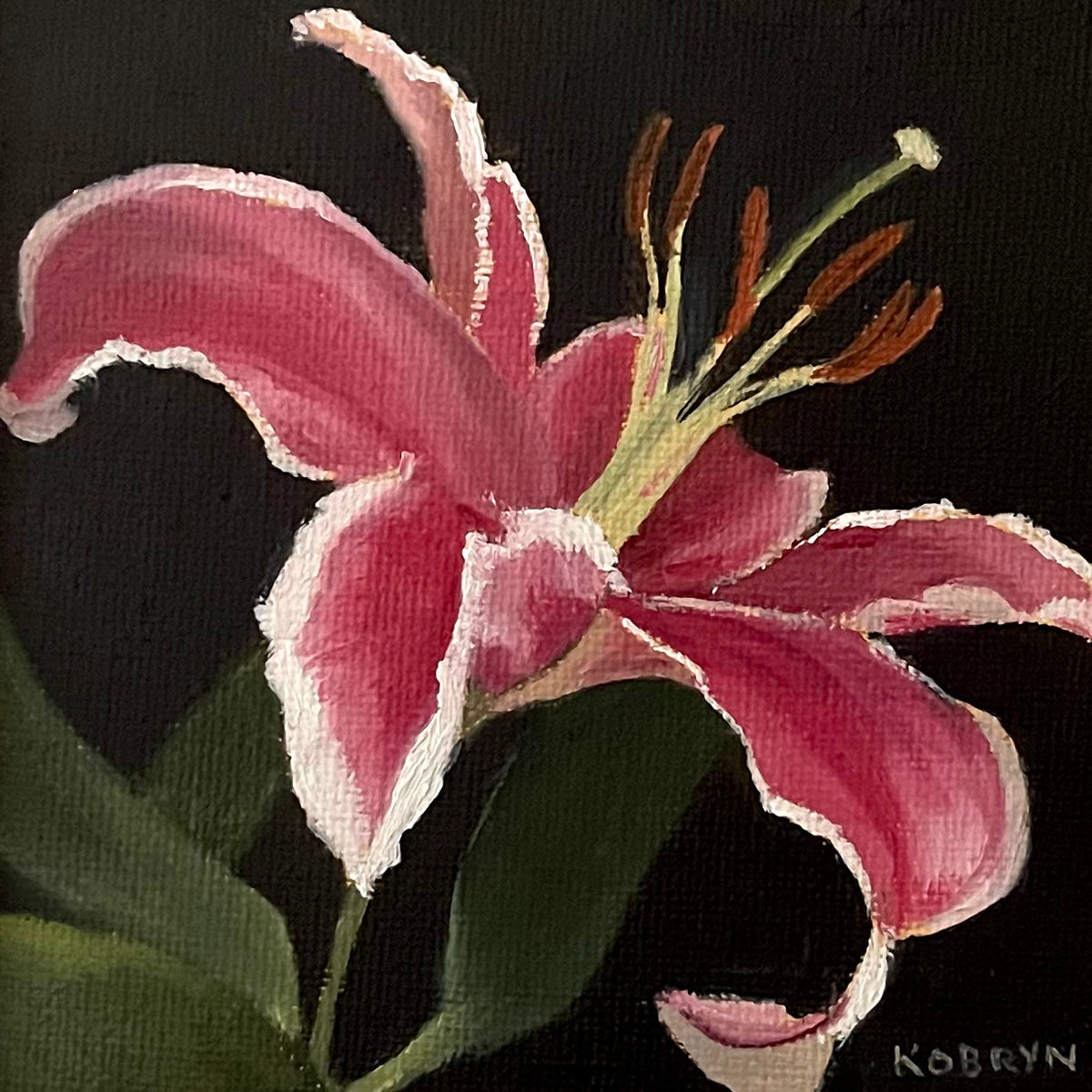
Set these eight side by side and the lily stops being a flower with a meaning and becomes a mirror. Kings saw power in it, mourners saw the soul, the devout saw chastity, modernists saw the body, and Monet saw nothing but light on water. The bloom never changed, we did. For me it carries one more meaning still: the lily is my daughter's favorite flower, so when I paint them, it's for her.